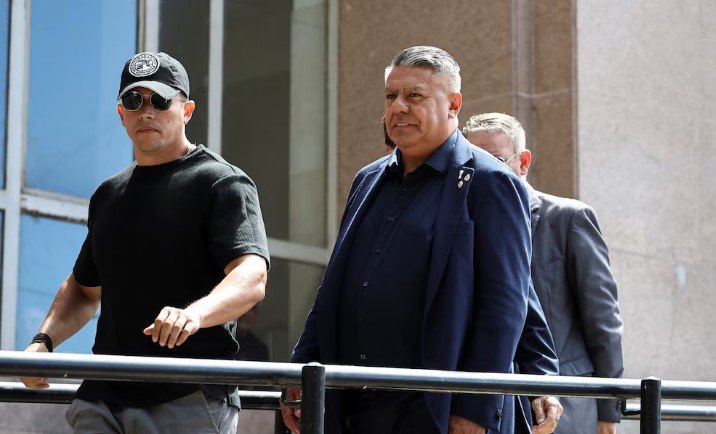

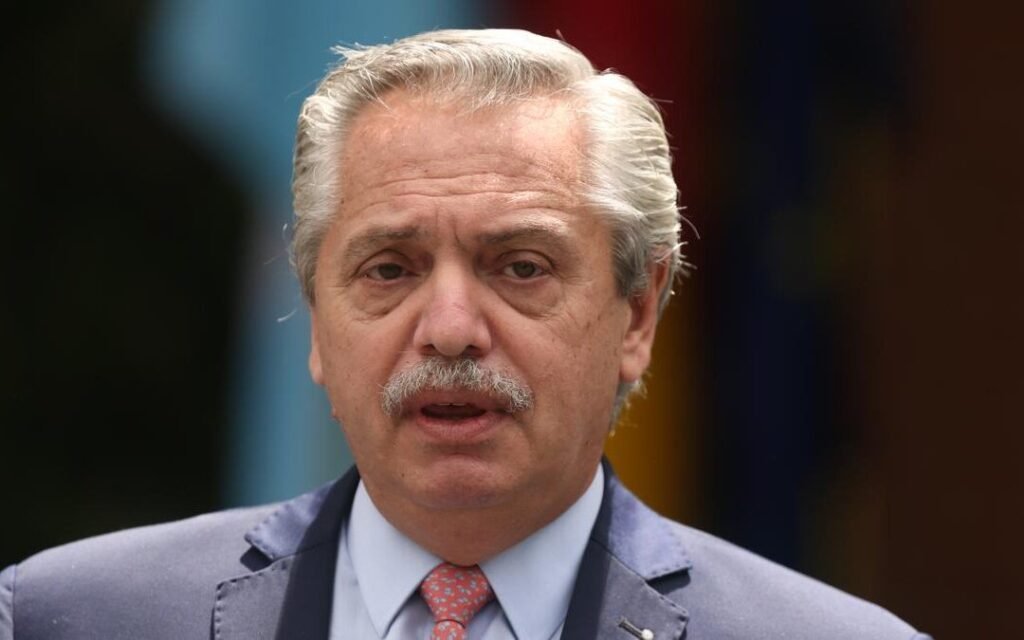
Former president Alberto Fernández at Comodoro Py as he asked the cassation court to overturn his indictment in the insurance case.
Former Argentine president Alberto Fernández personally appeared before Chamber IV of the Federal Criminal Cassation Court on Monday to ask judges to overturn his indictment in the so-called insurance case. He argued that he was ultimately charged over conduct for which he had never been properly questioned. Addressing judges Javier Carbajo, Gustavo Hornos, and Mariano Borinsky, Fernández asked the court to “do justice and revoke the indictment” issued against him on allegations of incompatible negotiations in the exercise of public office.
The hearing marked a new stage in one of the most politically sensitive corruption cases linked to Fernández’s administration. At the center of the dispute is not only the substance of the accusations, but also the procedure that led to the indictment. Fernández argued that when he previously appeared before the courts, he had always answered in relation to Decree 823/2021, but was later indicted under a broader theory that also included the appointment of his longtime secretary María Cantero and her alleged role in steering state insurance-related contracts.
Fernández told the court that he had not been given a fair opportunity to defend himself against the accusation as it was finally framed. He said the lower courts never allowed him to respond to the specific factual theory used to support the indictment. He also criticized the handling of the case from its early stages, claiming that former judge Julián Ercolini had shown open hostility toward him and that concerns about judicial impartiality had been ignored.
His appearance at Comodoro Py drew a visible security presence as he entered the courtroom in person, accompanied by his security detail. During the hearing, he combined legal arguments with a political message, telling the judges that accountability seemed to fall selectively on people who “think like Perón,” while urging the panel to reverse the ruling.
Defense Says the Indictment Went Beyond the Original Accusation
Fernández’s defense lawyer, Mariana Barbitta, told the cassation judges that the indictment should be set aside because, in her view, it violated the accusatory principle and ignored the autonomy and objectivity of the prosecution service.Barbitta pointed to an earlier stage of the proceedings in which prosecutor José Agüero Iturbe had concluded that there was not enough evidence, at that point, to support the accusation against Fernández with the required degree of certainty. According to the defense, that position should have carried particular weight because there was no true adversarial dispute on that issue: both the defense and the prosecutor had argued against sustaining the indictment.

Defense lawyer Mariana Barbitta argued that the indictment should be revoked because it went beyond the prosecution’s own position.
She acknowledged that a prosecutor’s opinion is not always binding on a judge. But in this case, she argued, the lower court should have acted with greater restraint and taken into account that the prosecution itself had not supported moving forward on the terms later adopted by the judges. In her reading, the problem was not just disagreement over the evidence, but a deeper procedural defect in the way the charges were maintained and expanded.
That is likely to be one of the main questions before cassation: whether Fernández was indicted on a factual and legal basis consistent with the accusation that had previously been put to him, and whether the lower courts respected due process during the investigative stage.
Prosecutor Supports Keeping the Indictment in Place
The prosecution before the cassation court took the opposite view. Federal Prosecutor General Raúl Omar Pleé supported maintaining the indictments, asset freezes, and travel bans requested against the former president in connection with the offense of incompatible negotiations in public office. In a written filing, Pleé argued that the defense appeal was inadmissible and said Fernández’s lawyers had failed to show a sufficiently grounded federal grievance.
According to Pleé, the defense had not presented a reasoned legal challenge to the prior rulings, but rather expressed disagreement with the way the lower courts had assessed the evidence. That position reinforces the prosecution’s effort to preserve the current procedural status of the case as it moves through appellate review.
The broader theory of the insurance case is that, through Decree 823/2021, Fernández allowed Nación Seguros to centralize the discretionary designation of intermediaries and private insurers without following ordinary selection procedures. Investigators have said that among the main beneficiaries were broker Héctor Martínez Sosa, described as close to Fernández; Martínez Sosa’s wife, María Cantero, who had served as Fernández’s secretary; and former Nación Seguros head Alberto Pagliano.
When issuing the indictment, Judge Sebastián Casanello said that during Pagliano’s tenure the state-owned insurer paid commissions for intermediation with public bodies mainly to three groups of brokers led by Martínez Sosa, Pablo Torres García, and Oscar Castello. According to the case file, those commissions totaled roughly 2.2 billion pesos, representing nearly 60 percent of all commissions paid to intermediaries on policies issued to state entities during Fernández’s presidency.
Investigators also argued that Cantero’s appointment as the president’s executive private secretary created an opportunity for her family circle to deepen and expand business dealings involving contracts with state agencies. Fernández has denied the accusation and now insists that the indictment rests on a theory he was never properly allowed to contest.
The cassation court must now decide whether the defense’s procedural objections are enough to overturn the indictment, or whether the case will continue under the legal framework already upheld by the lower courts. Whatever the outcome, the hearing has sharpened both the judicial and political dimensions of one of the most consequential cases still surrounding the former president.