
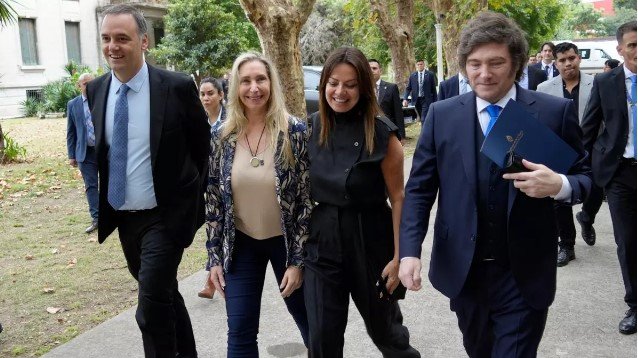
President Javier Milei with spokesperson Manuel Adorni, Human Capital Minister Sandra Pettovello, and Karina Milei.
Argentina’s Human Capital Ministry said it will appeal a court ruling that temporarily suspended key parts of the government’s labor reform, opening a new legal battle over one of the administration’s main policy changes. The ruling was issued after National Labor Court No. 63 granted interim relief in a case brought by the General Confederation of Labor (CGT), one of the country’s largest union federations.
In an official statement, the ministry led by Sandra Pettovello said it will seek to overturn the order that halted the application of part of Law No. 27.802 on labor modernization. Backed by the Treasury Attorney General’s Office, the government said it remains committed to the reform and will use every available legal avenue to restore its full effect.
The administration defended the law as a central part of its effort to promote formal employment, improve competitiveness, and give employers greater legal certainty. It also criticized the court challenge, arguing that it reflects sectoral interests trying to block changes approved by Congress.The ruling under appeal was issued by labor judge Raúl Ojeda, who granted a precautionary measure requested by the CGT and temporarily suspended more than 80 articles of the law. In his decision, the judge said there was a possible risk to constitutional rights and a danger of immediate harm to workers, which justified freezing the disputed provisions until the broader legal questions are decided.
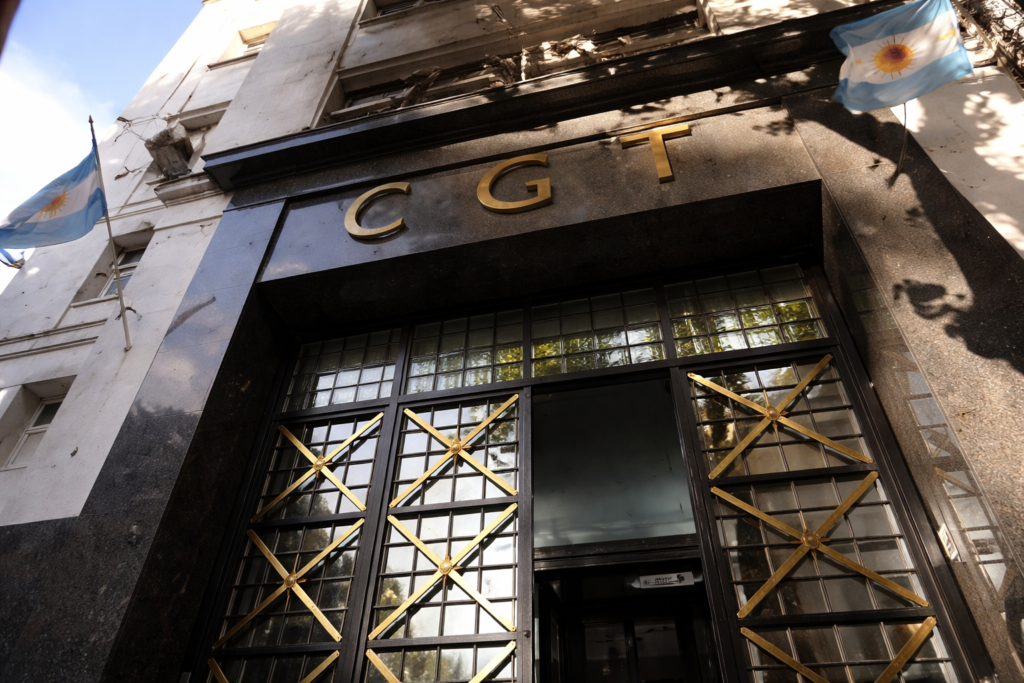
Headquarters of the CGT, the union federation that challenged the labor reform in court.
Labor Reform Dispute Moves Into a New Judicial Phase
The challenge was filed by the CGT’s current leadership trio — Jorge Alberto Sola, Octavio Argüello, and Cristian Jerónimo — who questioned the constitutionality of several parts of the reform. They asked the court to intervene before those changes could take effect, arguing that the law threatens protections recognized under Argentina’s constitutional and labor framework.
For now, the suspension is only provisional. It will remain in force while the courts carry out a fuller review of the law’s validity. In the meantime, existing collective bargaining agreements remain in effect, which was one of the union’s main concerns in the case.
The dispute now sets up a broader institutional clash over the future of the government’s labor agenda. The Milei administration has presented the reform as a necessary step to modernize the labor market and reduce obstacles to formal hiring. The unions, by contrast, say the suspended sections weaken labor protections and undermine collective rights.
Because the current ruling is an interim measure, the larger legal fight is still to come. The appeal announced by the ministry is expected to push the case into a new stage, with higher courts likely to review both the scope of the suspension and the constitutionality of the reform itself.
That means the case is no longer just a technical dispute over implementation. It has become a test of how far the government can go in advancing major labor changes when faced with immediate constitutional objections from organized labor. With part of the reform now frozen and the executive branch preparing to fight back in court, the issue is likely to remain at the center of Argentina’s legal and political debate in the coming weeks.