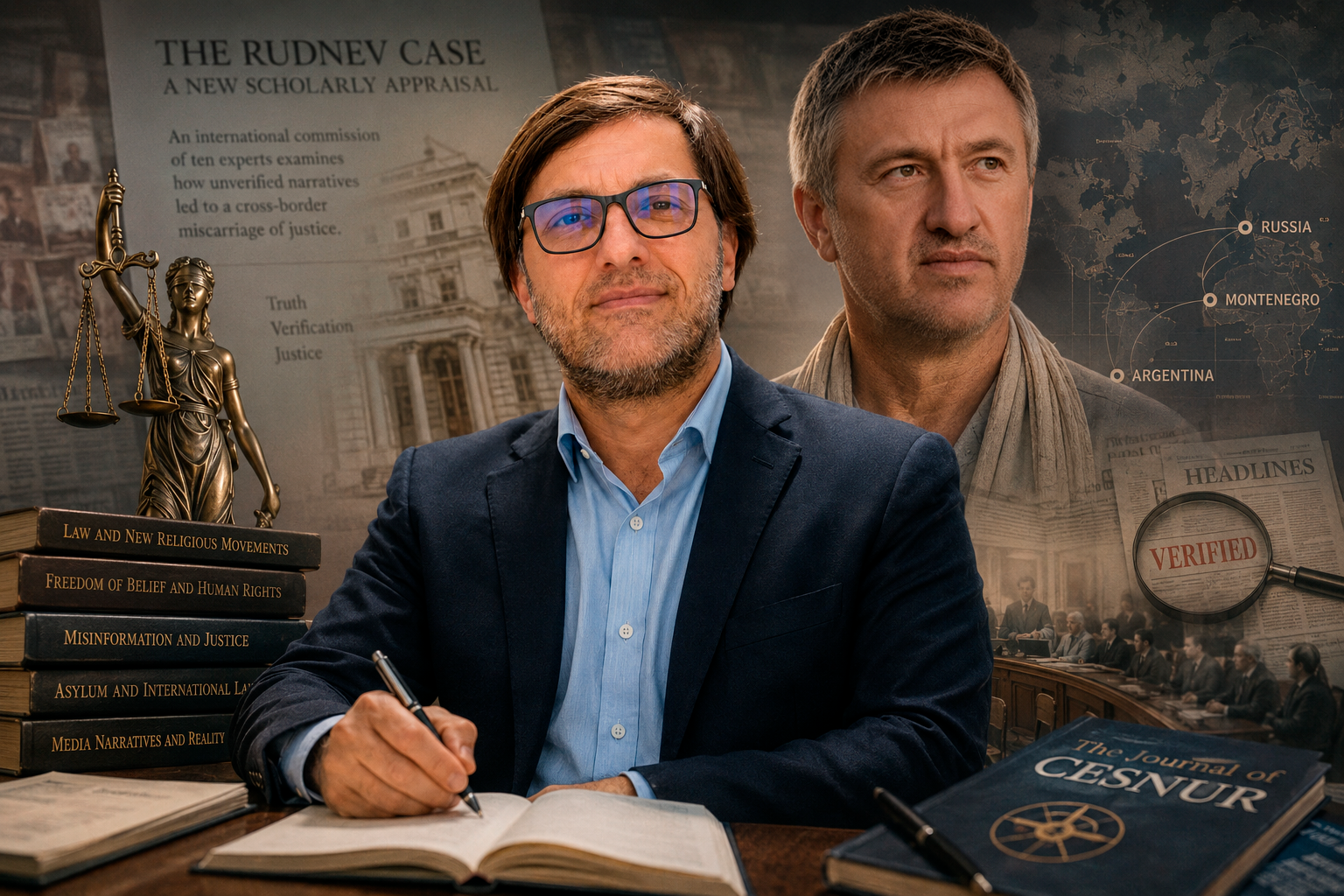

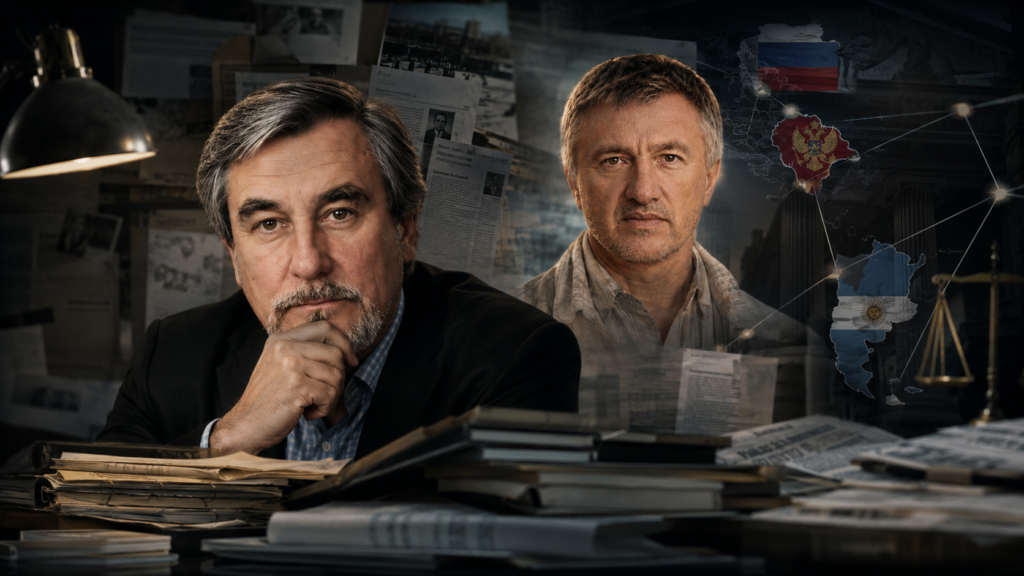
An international panel of experts reveals how unverified narratives drove a cross-border miscarriage of justice.
By Marco Respinti
A newly published set of studies on the long, convoluted history of Konstantin Rudnev and Ashram Shambhala appears at a time when discussion of minority spiritual movements is driven more by the momentum of repeated assertions than by genuine understanding. Building on earlier coverage in “Bitter Winter,” the volume is scheduled for release in late August as an annotated edition of “The Journal of CESNUR.” It is introduced by James T. Richardson, among the most distinguished scholars of law and religion, whose career has been dedicated to studying how legal systems engage with unconventional forms of faith. His framing of the Rudnev case highlights the seriousness of what the volume uncovers.
The ten authors represented in the book make up a body of expertise seldom gathered around a single case. Massimo Introvigne pieces together Rudnev’s early life and intellectual development. Patricia Duval dissects the Russian judicial proceedings with the rigor of a human-rights lawyer. Alessandro Amicarelli reviews the Montenegrin asylum situation from the perspective of an attorney focused on freedom of belief. María Vardé provides a legal-anthropological interpretation of the Argentine case. Márk Nemes and Karolina Maria Kotkowska lay out the doctrinal framework of Rudnev’s teachings. Susan J. Palmer records the accounts of Rudnev’s advanced students. Willy Fautré probes the influence of the Russian Orthodox Church on state policy. Rosita Šorytė examines how Rudnev’s public persona was constructed in Russian media. I authored a piece on the flow of information about Rudnev and on how journalism, once it discards its fundamental standards, can serve as a vehicle for distortion rather than enlightenment. Taken together, these ten writers functioned as a kind of commission—a joint undertaking to scrutinize a case long burdened by misinformation.
The evidence compiled in the volume shows that the Rudnev case did not play out within the orderly halls of institutions. It played out in the turbulent space of public communication, where narratives outrun facts and repetition frequently stands in for verification. The public came to know Rudnev through a patchwork of reports that were treated as established truth even when they rested on speculation. These accounts moved across borders with striking speed, molding perceptions in Russia, Montenegro, and Argentina well before any official investigation had concluded. The outcome was an atmosphere in which the presumption of guilt became the default perspective through which each subsequent development was read.
My own essay follows the making of this atmosphere. It tracks the path of claims that started as rumor, were echoed as news, and ultimately hardened into reference points for institutional actors. In many cases, the material in circulation was not merely imprecise but plainly false. Still, it was published, shared, and cited as though it had survived the standard filters of journalistic scrutiny. The Rudnev case thereby stands as a demonstration of how journalism can break down when it forsakes its duty to question sources, place information in context, and resist the pull of sensationalism.
The fallout from this breakdown reached beyond the media. In Russia, the press portrayal of Rudnev fostered a climate in which particular prosecutorial approaches seemed credible, even when they depended on notions such as “brainwashing” that scholars have long discredited. In Montenegro, the narrative brought in from abroad colored the setting in which Rudnev sought refuge, generating expectations and fears of “cult” activity that bore little relation to local conditions. In Argentina, a hospital episode was steadily recast as proof of an extensive criminal operation, resting on hypotheses never subjected to rigorous verification. Each country crafted its own variant of the story, yet every variant shared a single starting point: a media environment that had stopped examining the information it relayed.
The studies collected in the volume show that the Rudnev case is not merely a record of institutional failure. It is equally a record of how information, once warped, becomes almost impossible to set right. Once a particular image of a person or group takes hold, it tends to reproduce itself. Reporters draw on earlier articles, commentators lean on prior reports, and authorities assume the press has already performed the necessary groundwork. The result is a loop in which mistakes reinforce one another until they become indistinguishable from fact. The Rudnev case shows how hazardous this loop becomes when it meets legal proceedings that decide a person’s liberty and safety.
The collection is not a plea for Rudnev’s legal defense. Its aim is to re-establish the conditions under which a fair judgment can be reached. It examines documents, testimony, and procedural records with the care needed to distinguish what is actually known from what has merely been claimed. It reveals how the case was molded by forces reaching beyond the individuals directly involved. It also shows that journalism, when it fails to maintain its own standards, can help bring about deeply unjust results.
For journalists, the Rudnev case carries a lesson that should not be dismissed. It underscores the value of skepticism, the necessity of verifying sources, and the duty to push back against narratives that arrive prepackaged for publication. It also demonstrates how readily journalism can turn into a channel for misinformation when institutional pressures, ideological motives, or simple carelessness intervene. The consequences of such failures do not stay confined to newspaper pages. They touch real people, real communities, and real legal processes.
The articles approach the Rudnev case with a recognition of the larger forces that shaped it. The essays show that the persecution of minority spiritualities often begins not with official hostility but with stories that spread without challenge. Once those stories take root, they can sway institutions, mold public opinion, and warp legal proceedings. The Rudnev saga shows how vital it is for journalism to stay committed to accuracy, context, and fairness—above all when reporting on groups already exposed to misunderstanding.