

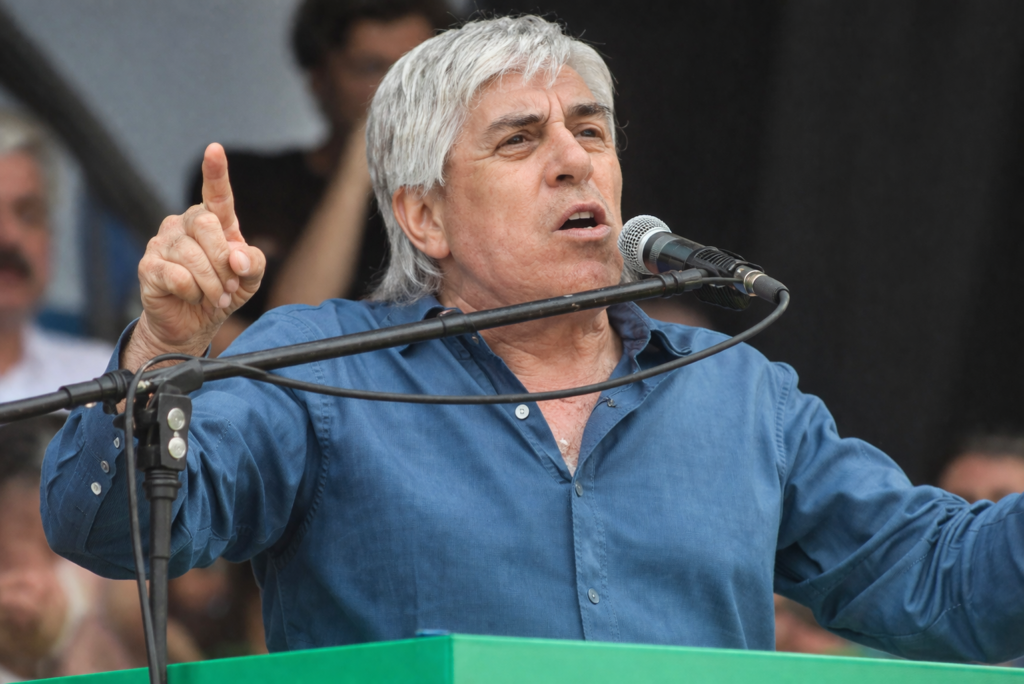
Hugo Moyano after being cleared in the Córdoba case.
A federal court in Córdoba has dismissed the case against veteran Teamsters union leader Hugo Moyano and several other defendants in proceedings that examined alleged money laundering, fraudulent administration, and false statements linked to the acquisition of union-owned real estate in the city of La Falda. The ruling followed a request by federal prosecutor Carlos Casas Nóblega, who asked that all defendants be cleared on different legal grounds, including lack of proof and expiration of the criminal limitation period.
The decision was issued by Federal Judge Alejandro Sánchez Freytes, who adopted the prosecutor’s position and brought the case to a close. The investigation had focused on a series of transactions involving five properties located opposite the Primero de Mayo hotel owned by the Teamsters union in La Falda, in Córdoba’s Punilla Valley. Prosecutors had examined whether the transactions were used to divert union funds and recycle allegedly illicit proceeds through the real estate market.
The case began after Argentina’s Financial Information Unit submitted a suspicious transaction report to the anti-money-laundering prosecutor’s office, Procelac, flagging unusual money movements connected to the purchase and resale of the properties. That report led to a criminal complaint in federal court and later to charges against Moyano and other individuals allegedly linked to the operations.
According to the original theory of the case, several of the defendants used the company Kiano S.A. to intervene in the real estate transactions, allegedly inflating the true value of the five lots and structuring the deals in a way that could conceal the origin and destination of the funds. Prosecutors alleged that one of the lots’ owners bought the properties in 2004, later sold them to Kiano in October 2013, and that Kiano then transferred them days later to another defendant, who subsequently assigned the rights to the Teamsters union for a much higher amount.
Why the Case Was Dismissed
Moyano and union official José Villegas had been accused of participating in those operations, allegedly using their positions in the union to divert funds and channel them through the property market. The investigation was later expanded to include additional alleged transactions involving apartments in the Chateau Mirage building in La Falda, which prosecutors said may have formed part of a second laundering scheme using funds supposedly generated by the earlier property deal.
But as the case moved forward, the prosecution’s position shifted. In 2024, prosecutor Casas Nóblega had sought to indict Moyano and Villegas for fraudulent administration. Before ruling, however, the judge asked him to determine whether the relevant crimes were still prosecutable or had already become time-barred. After that review, the prosecutor requested dismissal of all defendants.
With respect to Moyano and Villegas, the prosecution argued that the alleged fraudulent administration offense could no longer be pursued because the statute of limitations had expired. The judge agreed. As for the money-laundering accusation, the prosecutor said the case file contained only “merely conjectural indications” that were not sufficiently corroborated to prove a prior agreement, shared knowledge of an illicit source of funds, or coordinated participation in a common criminal operation.
Judge Sánchez Freytes added a key point in support of the dismissal: he said the evidence showed that the money used by the Teamsters union to acquire the properties came from the union’s own coffers, funded by contributions from its members, and therefore could not be treated as proceeds of an unlawful act. That finding directly undercut the prosecution’s laundering theory.

Federal court proceedings in Córdoba, where the case against Hugo Moyano and other defendants was closed.
Other Defendants Also Cleared
The court also dismissed the laundering charges against other defendants, including people linked to the company involved in the transactions, after the prosecutor concluded there was no direct evidence of a relationship sufficient to sustain the accusation. The judge adopted that reasoning as well. In addition, some defendants were cleared of fraudulent administration because the charges were time-barred, while one defendant was dismissed from the case due to death. Another, who had been accused of entering false information in a property deed, was also cleared because the alleged offense was barred by the statute of limitations.
The ruling closes a long-running case that had centered on whether a series of real estate transactions in Córdoba represented criminal misuse of union resources or a scheme to launder illicit funds. In the end, the court found that the record did not support that conclusion under the criminal standard required to proceed. For Moyano, the decision removes him from another high-profile judicial case and reinforces the importance of proof, causation, and procedural limits in financial crime investigations.