
First-Hand Account
This statement is being published for the first time.
This statement is based on the testimony of Konstantin Rudnev, transmitted by him from the maximum-security prison Rawson, Unidad 6, and recorded by his wife, Tamara. The events described below reflect the actual facts and conditions of detention reported by Konstantin following his arrest on March 28 in Argentina.

Straight to a Maximum-Security Prison
On March 28, Konstantin Rudnev was detained at the airport. After his arrest, he and his wife were immediately separated and spent the entire night in the airport building without explanation, without clarification of their procedural status, and without the provision of an interpreter.
The next day, Konstantin was immediately transferred to the maximum-security prison Rawson—a high-security facility located in the southern part of the country where temperatures were already below freezing.
His transfer to a maximum-security prison at the edge of the continent was carried out without official notifications, without justification, and without any explanation of the reasons. There was no legal basis for this decision.
“Under Article 210 of the Argentine Criminal Code, the principle of proportionality applies upon detention—temporary detention, travel restrictions, retention of documents, etc. But that didn’t happen. Konstantin was immediately taken to a maximum-security prison without any explanation,” recalls Tamara.
A Stone “Tomb” with Refrigerator Temperatures
Immediately upon arrival in Rawson, Konstantin was placed in a solitary confinement cell—a punitive isolation unit.
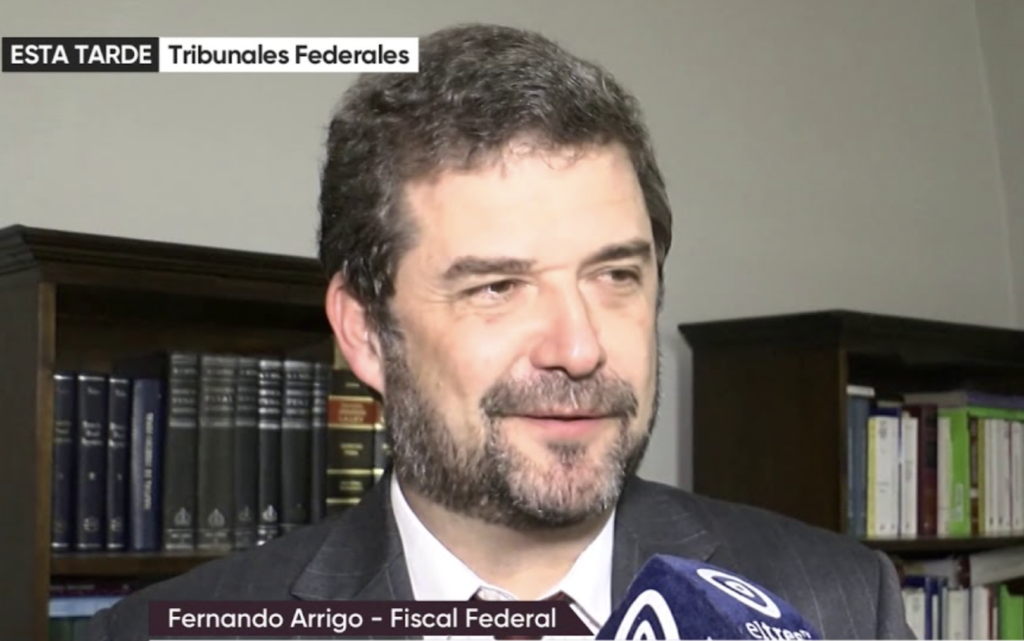
This decision was made by the Chief Prosecutor of the Rosario District, Fernando Oscar Arrigo and his assistants Tomás Labal, Gustavo Javier Revora, and Rodrigo Nicolás Treviranus, without explanation, without the involvement of an interpreter, and without informing him of his detention status.
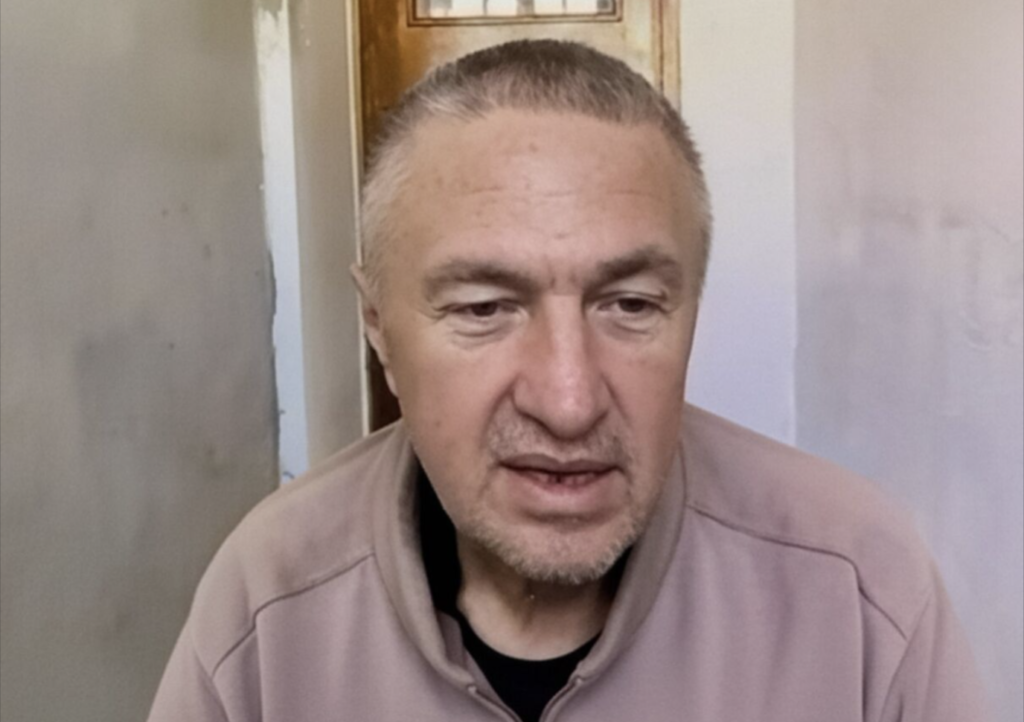
Konstantin was placed in solitary confinement without even understanding what was being said to him or why he was detained.
From March 28 until approximately April 7, he was held in conditions of extreme cold. He had only thin clothing—a T-shirt and a light sweater. He was not given warm clothing, shoes, blankets, or anything else to protect him from the cold.
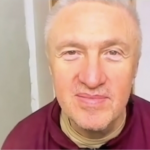
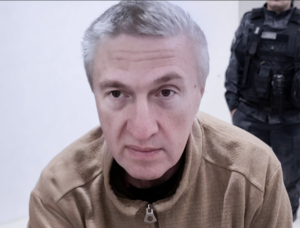
“During the first hearing, when I saw him via video link for the first time after the arrest, he was constantly hugging himself and breathing into the fabric of his sweater, trying to keep warm,” says Tamara.
A Bucket, a Plastic Bag with Porridge, and Water from the Tap
The conditions of confinement in the solitary cell were degrading to human dignity.
Until April 10, there was no toilet in the cell—a plastic bucket was used instead. Konstantin was not even given cutlery: food was handed to him in plastic bags, and he was forced to eat with his hands.
Drinking water came directly from the tap and was of extremely poor quality. Basic sanitary and hygienic conditions were absent.
As a result, for 10 days, Konstantin ate only bread and tap water.
It is important to note that Konstantin Rudnev suffers from chronic gastrointestinal diseases, including chronic diarrhea.
Within the first days of incarceration, he began to lose weight rapidly. Constant weakness, dehydration, and physical exhaustion became his daily state.
Forced to Take Unknown Pills and Checked to Ensure He Swallowed Them
“While Konstantin was held in this stone solitary confinement box, he was taken to doctors at four in the morning without explanation. He was forced to take three pills daily without being told their name, composition, or purpose,” says Tamara. “With each day, these pills made him feel worse.”
The medication intake process was monitored by guards: he was forced to open his mouth to confirm the pills were swallowed. An interpreter was not provided during these procedures.
Only after filing a habeas corpus petition and obtaining medical documents did it become known that he was being given strong blood pressure-lowering medication. This explains the bouts of severe weakness, fainting spells, and near loss of consciousness.
Nevertheless, the prison authorities later denied any connection between the medication and the deterioration of his condition.
Denial of Access to Defense and an Interpreter
Until April 3, Konstantin had no opportunity to meet with his private lawyer.
Even in court, he did not understand who exactly was his defense attorney until he was informed directly in the courtroom. His first full meeting with a lawyer took place only on April 9, after the judge had already ruled on the initial six-day detention.
Despite a court order for the provision of an official interpreter, this requirement has been systematically ignored to this day.
Konstantin continues to be taken for medical examinations and check-ups without translation, including visits to civilian hospitals, which is a direct violation of the law and his procedural rights.
Conclusion
The totality of the presented facts indicates not merely isolated procedural violations, but a systemic and gross disregard for international standards of prisoner treatment, principles of humanity, and fundamental human rights.
This constitutes a violation of human rights according to Inter-American standards—without consent, without proper legal grounds, and without the presence of verifiable facts—depriving a person of liberty under conditions that in themselves can be qualified as inhuman and degrading treatment and, under certain laws, may be equated to torture.
The defense insists: Konstantin Rudnev is being illegally deprived of his liberty and must be immediately released, and the case must be closed.
Konstantin Rudnev’s lawyer, Carlos Broitman, has officially stated that the criminal case against his client shows all signs of fabrication and lacks any element of a crime. In his words:
“This case lacks legal grounds for criminal prosecution. The charges are based on distorted and unreliable materials. In fact, we are dealing with a fabricated case and illegal deprivation of liberty.”
The defense emphasizes that the continued detention of Konstantin Rudnev is unjustified and contradicts both Argentine legislation and Argentina’s international human rights obligations.
This case requires external intervention and its complete termination.What is happening is not a private incident or a “systemic error,” but a dangerous precedent demonstrating that torture cannot be permitted in Argentine prisons, in a place where the state is obligated to protect human dignity and human rights.